
- Follow us:
- Our Commodities:
-



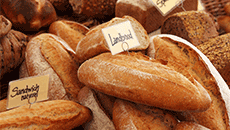
South Africa’s wheat industry stands at a crossroads - and what happens on the farm today ultimately affects almost every household in the country.
This was the central message from today’s Agri in Conversation: Winter Grains - Wheat at a Crossroads at NAMPO Cape, where producers, economists and role players across the value chain discussed the future of local wheat production.
The conversation focused on a simple but urgent question: How does South Africa ensure that local wheat production remains viable over the long term while producers are increasingly squeezed by high production costs, climate risk, poor returns on capital, an ineffective price formation mechanism and structural market challenges?
For the public, the significance extends far beyond the farm gate.
Wheat-based products are consumed by approximately 96% of South African households and account for around 12% of the average household food basket. Approximately 90% of the population regularly relies on wheat-based foods, with bread by far the most important product and accounting for roughly half of household expenditure on wheat products.
Wheat is therefore not merely an agricultural commodity. It forms part of South Africa’s basic food infrastructure.
At the same time, it is an industry with a significant economic and social footprint. The wheat value chain contributes an estimated R70 billion to R75 billion to the South African economy and supports approximately 90 000 jobs across farming, input supply, processing, trade, transport and related services.
Milling and baking activities alone support around 55 000 formal jobs, while the broader trade sector linked to wheat products supports approximately another 25 000 jobs. The formal baking industry generates an estimated R27 billion in Gross Value Added.
The Western Cape, which produces approximately 55% of South Africa’s wheat, accounts for a particularly significant share of this economic and social value. An estimated 27 000 formal jobs in the province are supported by the wheat value chain.
Wheat production also sustains a much broader economic network: fertiliser, crop protection, fuel, electricity, insurance, transport, storage, financing and agricultural machinery. These indirect activities contribute an estimated R23 billion in value added, while approximately R5 billion in input-related economic activity and 10 000 to 12 000 jobs could be directly vulnerable should local production decline further.
This is why the current situation cannot simply be regarded as a producer problem.
South Africa already produces only around half of the wheat it consumes. At the same time, the area planted to wheat is at its lowest level in almost a century (97 years), while the 2026 crop is currently estimated at approximately 1.7625 million tonnes - already 7.5% lower than in 2025.
Western Cape production is currently estimated at approximately 874 500 tonnes, 105 600 tonnes lower than in 2025, with the Swartland experiencing severe rainfall deficits and potential crop losses this year, which could negatively impact this figure even further.
The challenge is therefore not whether South Africa should import wheat - imports already form part of the local supply model. The greater strategic question is how much local production capacity South Africa is willing to lose before the country’s exposure to international markets, exchange rates, logistical disruptions and food-security risks becomes unacceptable.
Producers deliver quality - but are not compensated for it
One of the most important issues highlighted during the discussion is the growing imbalance between the quality of South African wheat and the value that flows back to the farm.
BFAP’s analysis points to a so-called “quality-price paradox”: in 2024/25, local wheat demonstrated approximately 39% higher baking value and 14% higher milling value than comparable imported wheat, while the local grade-weighted SAFEX price was approximately 9%, or around R700 per tonne, lower than the weighted imported price.
This raises a fundamental question for the value chain: If South Africa expects producers to invest in better genetics, quality and production technology, the market must also be able to recognise and reward that value.
Current price formation mechanisms, grading, basis premiums, the tariff system and location differentials must therefore be better aligned with the actual milling and baking value of locally produced wheat.
This is particularly relevant in a year such as 2026. With a smaller Western Cape crop and severe pressure in the Swartland, location differentials based on normal grain flows should not simply be applied mechanically in an abnormal short-crop year without reconsidering actual supply and demand conditions.
A tariff that responds too late does not protect when protection is needed
South African wheat producers compete with imported products from international production environments where producers often receive significant government and other forms of support.
The wheat tariff therefore remains an essential instrument in creating a more level playing field.
But the tariff must be predictable, reactive and timely. Support that only materialises after commercial damage has already occurred does not achieve its policy objective.
The discussion emphasised that South Africa is not seeking protection from competition. Local producers want to compete with international producers - but they should not simultaneously be expected to compete against the support systems of foreign governments while being constrained by quality requirements.
Climate risk cannot remain indefinitely on the farm
The current drought conditions in the Swartland also demonstrate how quickly production risk lands on the producer’s balance sheet after inputs have already been committed and production decisions made.
This is why Grain SA continues to advocate with authorities for an affordable and workable crop insurance model and shared risk mechanisms.
Crop insurance should not be viewed as “farmer assistance”. In a strategically important food industry, it is economic infrastructure that helps protect production capacity, jobs, rural communities and, ultimately, food supply.
Today’s technology determines tomorrow’s harvest
South Africa must, at the same time, enable faster access to improved genetics, new cultivars and production technology.
The country must recognise the excellent quality for which locally produced wheat is known, but regulation and cultivar-release processes should not become so restrictive that yield progress, producer choice and international competitiveness suffer as a result.
The challenge is to protect both quality and innovation - not one at the expense of the other.
Government now has an opportunity to act
Grain SA believes the current Section 7 process concerning the wheat industry provides an important opportunity to move from diagnosis to solutions.
The process is examining, among other matters, trade and tariff policy, value-chain efficiency, storage, infrastructure, logistics, food security and innovation.
The outcome must now lead to practical, evidence-based recommendations that protect local production capacity, make the tariff system more responsive, better align price formation and differentials with actual market value, accelerate access to technology and establish a workable partnership around crop risk and crop insurance.
South Africa does not have to choose between the consumer and the producer. A healthy local wheat industry is in the interests of both.
This is particularly relevant for lower-income households: wheat-based products account for approximately 15% of food expenditure among the poorest households. Food affordability therefore remains critical.
But affordable food cannot, over the long term, be built on a local production base that is being economically depleted. The impact of the wheat price on the price of final consumer products is small and limited.
The warning from NAMPO Cape is clear: South Africa should not wait until local wheat-production capacity has disappeared before acting.
Wheat feeds South Africa, supports thousands of jobs, sustains rural economies and supplies an extensive manufacturing and food industry.
To retain that contribution, it must remain economically viable to plant wheat on South African fields.
ENDS