
- Follow us:
- Our Commodities:
-



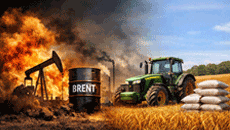
The ongoing conflict in the Middle East has introduced significant volatility into global energy markets, with Brent crude oil prices rising sharply in recent weeks. These increases are already flowing through to international diesel prices and global fertiliser markets, creating mounting cost pressures for South Africa’s grain and oilseed producers.
Diesel makes up between 13% and 15% of a grain and oilseed producer’s variable production costs, and South Africa imports a significant share of its domestic diesel requirements. This leaves the agricultural sector highly vulnerable to global price shocks. Fertiliser, of which more than 80% is imported, accounts for 30% to 50% of producers’ variable production costs, meaning rising energy prices place farmers under compounded cost pressure.
Grain SA has, in recent correspondence to the Department of Mineral Resources and Energy and the National Treasury cautioned that current trends could result in a substantial increase in the next regulated diesel price adjustment, exceeding R8 per litre, a development that would place additional financial pressure on consumers, transport operators and key sectors of the economy with the impact “particularly severe for the agricultural sector.”
The Chairperson of Grain SA, Richard Krige, expressed deep concern about the pressure producers are facing, describing it as “one of the most significant cost shocks in recent years”. He added:
“As South Africa prepares for winter cereal planting and the harvesting of summer crops, the combined effects of rising diesel and fertiliser prices present one of the most significant cost shocks to producers in recent years. Without temporary relief and responsible behaviour from all players in the value chain, the impact on farmer viability - and therefore food security - could be severe.”
Krige’s comments echo concerns raised in Grain SA’s formal submissions to government, which note that fuel constitutes around 14% of total production costs in primary farming and that energy‑driven increases directly influence fertiliser prices, further amplifying cost pressures across the grain value chain and creating an adverse impact for grain and oilseed producers.
Grain SA has also written to the Fertiliser Association of South Africa (FERTASA) after receiving reports that some fertiliser companies may be increasing prices based on global events, despite holding stock procured at lower pre‑conflict prices. The organisation urges suppliers to avoid opportunistic or unjustified price increases during this critical period for winter cereal producers, particularly in the Western Cape.
The CEO of Grain SA, Dr. Tobias Doyer, emphasised the importance of industry‑wide responsibility:
“Global crises should not be used as a pretext for unnecessary price increases in South Africa. We are calling on fertiliser companies, fuel suppliers and government partners to work with us to stabilise the sector during this volatile period. Farmers cannot absorb unlimited input‑cost shocks, and South Africa cannot afford disruptions in food production.”
His remarks reinforce the organisation’s call for coordinated value-chain-wide action to protect the agricultural sector from unnecessary cost escalation.
Grain SA is also engaging diesel suppliers and distributors to ensure sufficient diesel allocation for the winter cereal planting season and the rapidly approaching summer grain harvesting season. Ensuring availability is essential to maintain uninterrupted food production during a period of elevated geopolitical uncertainty.
To mitigate immediate risks, Grain SA has made formal requests to the government and industry organisations for:
Grain SA also notes that while farmers receive 40% of the General Fuel Levy and 100% of the Road Accident Fund levy back through the diesel rebate system, a temporary enhancement of this rebate could provide critical short-term relief.
“At a time when margins are already under pressure, the sustainability of grain production depends not only on global conditions, but on how effectively domestic stakeholders respond.”, Doyer concluded.
Ends
Issued by: Grain SA Communications
Further enquiries:
Corné Louw, Head: Applied Economics & Member Services, Grain SA
corne@grainsa.co.za