
- Follow us:
- Our Commodities:
-



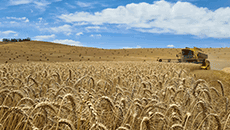
South Africa’s wheat industry is facing a structural economic failure that now threatens producer survival, future planting decisions and the country’s long-term food security, Grain SA warned following a series of regional meetings held across the Western Cape winter grain production areas.
The meetings, hosted in the Swartland, Overberg and Southern Cape, brought together wheat producers, Grain SA leadership and industry stakeholders to assess the realities facing the sector. Across all regions, producers delivered a consistent and urgent message: wheat farming under current market and policy conditions is no longer economically sustainable, and intervention from the broader value chain is critical.
These engagements follow Grain SA’s ongoing public warnings regarding the wheat crisis, including concerns around delayed tariff responsiveness, the timing of imports, rising production costs and increasing exposure to subsidised international competition. Feedback from producers confirmed that these pressures are no longer theoretical - they are directly influencing planting decisions, capital investment and the willingness of producers to remain in wheat production.
“What we heard clearly and repeatedly is that producers are not talking about weathering another difficult season,” said Tobias Doyer, CEO of Grain SA. “They are questioning whether wheat still has a place in their crop mix under the current system.”
A structural squeeze, not a temporary downturn
Discussions at the regional meetings reinforced Grain SA’s position that the wheat crisis cannot be explained by low international prices alone. Producers described a persistent price–cost squeeze that has intensified over multiple seasons, driven by structural failures across policy, trade and the value chain.
Key issues raised consistently across regions included:
Producers highlighted that while farm-gate wheat prices adjust downward rapidly, the same responsiveness is not observed elsewhere in the value chain. Economic analysis presented at the meetings showed that wheat contributes a relatively small proportion to the final bread price, yet producers bear a disproportionate share of downside risk.
“This is not a functioning free market correction,” Doyer said. “It is a structurally distorted system where producers carry losses while cost pressures elsewhere in the chain are not adjusting at the same pace.”
Import timing and tariff responsiveness under scrutiny
A central concern raised during the meetings was the timing of wheat imports, particularly during the months immediately preceding the local harvest. Consequently, a local oversupply is created. Producers warned that import volumes entering the market during September and October exert direct downward pressure on domestic prices at the most vulnerable point in the production cycle.
While South Africa has a variable wheat import tariff intended to provide a level of protection against depressed international prices, producers expressed deep frustration that administrative delays and lagged implementation have rendered the mechanism ineffective when it is most needed.
“The issue is not the existence of policy tools, but their failure to respond in time,” Doyer said. “A protection mechanism that activates too late offers no protection at all.”
Competing against subsidies - without support
Producers also raised concern about South Africa’s position in the global wheat market, where local producers compete against imports from countries that actively support their wheat sectors through subsidies, insurance mechanisms and direct cost relief.
By contrast, South African wheat producers receive no direct production support and rely primarily on market-based mechanisms that are currently failing to respond adequately to structural pressure.
This imbalance, producers warned, is accelerating the exit of otherwise viable farmers from wheat production, increasing South Africa’s long-term reliance on imports and exposing the country to global supply shocks.
Unbalanced Competitive market within the physical market – JSE area differential
Producers also raised serious concern about the functioning of the domestic physical wheat market, particularly the interaction between the SAFEX reference price on the JSE and the current area differential.
Producers warned that the reference price and differential combination no longer reflect the realities of the physical market and is creating a structurally uncompetitive environment at farm level.
Grain SA said it is actively engaging on alternative differential mechanisms currently under consideration and will continue to support processes aimed at addressing competitive imbalances in the market.
Ministerial engagement confirms urgency - action must now follow
The structural risks raised by producers during the regional meetings have also been acknowledged at government level. In a recent podcast discussion between Grain SA and the Minister of Agriculture, the challenges facing South Africa’s wheat producers - including global subsidy imbalances, rising input costs and policy responsiveness - were openly discussed.
During the discussion, the Minister recognised that South African wheat producers are competing in an uneven global environment, without the direct support mechanisms available to producers in many major exporting countries, and that prolonged pressure on local production poses a risk to future food security.
Grain SA welcomed this engagement and the openness of the discussion but stressed that acknowledgement must now translate into timely and effective intervention.
“Constructive engagement is an important step,” said Tobias Doyer. “But producers cannot survive on dialogue alone. The policy tools exist - what matters now is how quickly and effectively they are implemented.”
The organisation said the regional meetings reinforced that delays in implementation, rather than a lack of understanding, are now the greatest threat to producer viability.
Input suppliers must share the adjustment
In addition to policy and trade concerns, producers raised strong concerns regarding input cost behaviour.
Despite easing global commodity prices, periods of currency strength and stabilising energy indicators, producers reported limited downward movement in input prices, particularly for fertiliser, chemicals, energy and mechanisation-related costs.
Producers warned that while they are expected to absorb falling output prices immediately, input costs have remained elevated and inflexible, further deepening the profitability squeeze at farm level.
“Producer survival cannot depend on farmers alone absorbing every structural adjustment,” Doyer said. “If wheat producers are expected to compete globally, then the entire system must respond to changing conditions. Input suppliers, like all parts of the value chain, have a responsibility to contribute to restoring sustainability.”
Grain SA called for greater transparency, responsiveness and fairness in input pricing, cautioning that without shared adjustment across the value chain, continued wheat production will become increasingly unviable.
What must change to protect producer viability
Based on producer input, economic analysis and ongoing engagement with policymakers, Grain SA is calling for urgent, coordinated intervention to prevent irreversible damage to the wheat sector:
Producers warned that once wheat capacity is lost, productive land, skills and infrastructure cannot easily be restored.
Producer survival is a national interest
Wheat producers stressed that the consequences of inaction extend beyond individual farms. Reduced local production increases import dependence, undermines rural economies and exposes consumers to greater global price and supply volatility.
“This is not about shielding inefficiency or resisting market forces,” Doyer said. “It is about correcting structural failures that are forcing viable producers out of production. If wheat producers disappear, South Africa inherits a long-term food security risk that cannot be solved overnight.”
Grain SA confirmed that it will intensify engagements with government, regulators, millers, input suppliers and other value-chain partners in the coming months, while escalating public advocacy to ensure that the wheat crisis is addressed as a structural economic risk, not a temporary inconvenience.
Ends
Issued by: Grain SA Communications
Further enquiries:
Dirk Strydom, MD, NAMPO (Pty) Ltd
dirks@grainsa.co.za