PART 1: The production cycle
Producing a calf every year is one of the most important objectives in a profitable beef cattle enterprise. However, good reproductive performance does not begin when the bull is placed with the cows. It starts much earlier, with veld management, nutrition, animal growth, body condition, weighing and planning the breeding season.
The introduction of controlled grazing systems, such as camps and rotational grazing, together with controlled breeding seasons, has allowed livestock farmers to manage their animals more efficiently. Instead of allowing cattle to breed and calve year-round, the farmer can align the herd’s production cycle with the period when the farm naturally provides its best nutrition.
This is important because the farmer is always working with two closely linked cycles:
- The environmental cycle, which is mainly influenced by the rainfall and temperature, and determines the quantity and quality of grazing available throughout the year.
- The animal’s production cycle, which determines how much nutrition the cow requires at various stages such as pregnancy, calving, lactation, mating and the dry period.
Successful livestock management is largely about bringing these two cycles together.
LET THE VELD SUPPORT THE PRODUCTION CYCLE
The nutritional requirements of a cow do not remain the same throughout the year. A dry cow has a relatively low requirement compared with a cow that has recently calved, is producing milk and must become pregnant again. This period after calving is particularly demanding.
A cow needs sufficient nutrients to maintain herself, produce milk for her calf and recover reproductively so that she can conceive again. If she calves during poor grazing, the farmer may have to provide considerable supplementary feed to meet the resulting nutritional shortfall. This can quickly become expensive.
Consider a simple example. If a cow consumes about 10 kg of poor-quality dry grass containing only 5% crude protein, the grazing provides approximately 500 g of crude protein. A dry cow may require only a relatively small additional amount of protein. However, a lactating cow that must produce milk and prepare to conceive again has a much higher requirement. The difference has to come from somewhere. If the veld cannot provide it, the farmer must provide it through supplementation. When this has to be done for many cows over a lengthy period, feed costs increase significantly.
For this reason, one of the most effective ways of reducing production costs is to plan the calving season so that the cow’s period of highest nutritional demand coincides as closely as possible with the period when the farm has its best natural grazing.
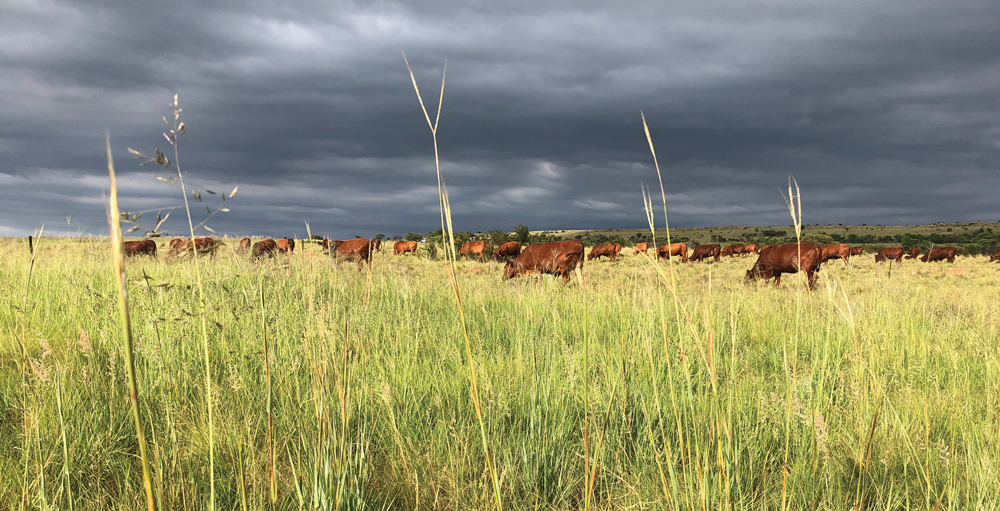
The farmer should therefore aim for cows to calve shortly before the best grazing becomes available. In a summer-rainfall environment, this allows improving summer veld to support milk production, recovery after calving and preparation for the next mating period. The veld then becomes an important part of the reproductive programme rather than simply a place where cattle graze.
Control the breeding season
The timing of mating is one of the production factors that the farmer can control. Once the breeding season begins, the approximate calving period can also be predicted, as a cow is pregnant for roughly nine months. A defined mating season therefore gives structure to the entire production year.
In many summer-rainfall areas, cows can be mated during summer so that they calve at the beginning of the following summer grazing period. The exact months will vary by region because rainfall patterns differ. Farmers in drier areas, where effective rainfall arrives later, may need to breed later than farmers in wetter areas.The principle is more important than the exact date. The breeding calendar should follow the farm’s feed calendar.
A controlled breeding season of less than about three months also creates a more concentrated calving season. This makes management easier because calving, vaccinations, weighing, weaning, pregnancy diagnosis and marketing can all be carried out on more uniform groups of animals. It also becomes much easier to measure the reproductive performance.
When bulls remain with the herd throughout the year, it can be difficult to know exactly when cows were exposed, when they should calve and which animals have failed reproductively. A defined mating season produces clearer information and allows the farmer to identify problem animals much sooner.
Natural mating is a practical breeding system for many developing and commercial cattle farmers. It requires less specialised infrastructure and technical intervention than some assisted reproductive systems, but this does not mean the bull should simply remain with the cows permanently. Natural mating works best when it is planned and controlled.
Publication: September 2026
Section: Pula/Imvula
Author: MLIBO QOTOYI − JUNIOR OPERATIONS MANAGER: PGP
